Malocclusion: Disease of Civilization, Part VI

Early Postnatal Face and Jaw Development

The face and jaws change more from birth to age four than at any other period of development after birth. At birth, infants have no teeth and their skull bones have not yet fused, allowing rapid growth. This period has a strong influence on the development of the jaws and face. The majority of malocclusions are established by the end this stage of development. Birth is the point at which the infant begins using its jaws and facial musculature in earnest.

The development of the jaws and face is very plastic, particularly during this period. Genes do not determine the absolute size or shape of any body structure. Genes carry the blueprint for all structures, and influence their size and shape, but structures develop relative to one another and in response to the forces applied to them during growth. This is how orthodontists can change tooth alignment and occlusion by applying force to the teeth and jaws.

Influences on Early Postnatal Face and Jaw Development

In 1987, Miriam H. Labbok and colleagues published a subset of the results of the National Health Interview survey (now called NHANES) in the American Journal of Preventive Medicine. Their article was provocatively titled "Does Breast-feeding Protect Against Malocclusion"? The study examined the occlusion of nearly 10,000 children, and interviewed the parents to determine the duration of breast feeding. Here's what they found:

The longer the infants were breastfed, the lower their likelihood of major malocclusion. The longest category was "greater than 12 months", in which the prevalence of malocclusion was less than half that of infants who were breastfed for three months or less. Hunter-gatherers and other non-industrial populations typically breastfeed for 2-4 years, but this is rare in affluent nations. Only two percent of the mothers in this study breastfed for longer than one year.

The prevalence and duration of breastfeeding have increased dramatically in the US since the 1970s, with the prevalence doubling between 1970 and 1980 (NHANES). The prevalence of malocclusion in the US has decreased somewhat in the last half-century, but is still very common (NHANES).

Several, but not all studies have found that infants who were breastfed have a smaller risk of malocclusion later in life (1, 2, 3). However, what has been more consistent is the association between non-nutritive sucking and malocclusion. Non-nutritive sucking (NNS) is when a child sucks on an object without getting calories out of it. This includes pacifier sucking, which is strongly associated with malocclusion*, and finger sucking, which is also associated to a lesser degree.

The longer a child engages in NNS, the higher his or her risk of malocclusion. The following graph is based on data from a study of nearly 700 children in Iowa (free full text). It charts the prevalence of three types of malocclusion (anterior open bite, posterior crossbite and excessive overjet) broken down by the duration of the NNS habit:

As you can see, there's a massive association. Children who sucked pacifiers or their fingers for more than four years had a 71 percent chance of having one of these three specific types of malocclusion, compared with 14 percent of children who sucked for less than a year. The association between NNS and malocclusion appeared after two years of NNS. Other studies have come to similar conclusions, including a 2006 literature review (1, 2, 3).

Bottle feeding, as opposed to direct breast feeding, is also associated with a higher risk of malocclusion (1, 2). One of the most important functions of breast feeding may be to displace NNS and bottle feeding. Hunter-gatherers and non-industrial cultures breast fed their children on demand, typically for 2-4 years, in addition to giving them solid food.

In my opinion, it's likely that NNS beyond two years of age, and bottle feeding to a lesser extent, cause a large proportion of the malocclusions in modern societies. Pacifier use seems to be particularly problematic, and finger sucking to a lesser degree.

How Do Breastfeeding, Bottle Feeding and NNS Affect Occlusion?

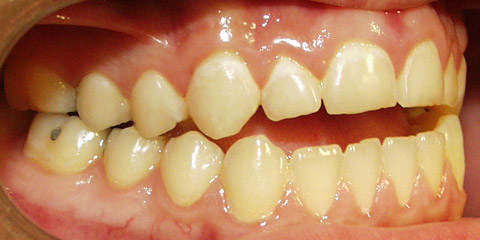
Since jaw development is influenced by the forces applied to them, it makes sense that the type of feeding during this period could have a major impact on occlusion. Children who have a prolonged pacifier habit are at high risk for open bite, a type of malocclusion in which the incisors don't come together when the jaws are closed. You can see a picture here. The teeth and jaws mold to the shape of the pacifier over time. This is because the growth patterns of bones respond to the forces that are applied to them. I suspect this is true for other parts of the skeleton as well.

Any force applied to the jaws that does not approximate the natural forces of breastfeeding or chewing and swallowing food, will put a child at risk of malocclusion during this period of his or her life. This includes NNS and bottle feeding. Pacifier sucking, finger sucking and bottle feeding promote patterns of muscular activity that result in weak jaw muscles and abnormal development of bony structures, whereas breastfeeding, chewing and swallowing strengthen jaw muscles and promote normal development (review article). This makes sense, because our species evolved in an environment where the breast and solid foods were the predominant objects that entered a child's mouth.

What Can We do About it?

In an ideal world (ideal for occlusion), mothers would breast feed on demand for 2-4 years, and introduce solid food about halfway through the first year, as our species has done since the beginning of time. For better or worse, we live in a different world than our ancestors, so this strategy will be difficult or impossible for many people. Are there any alternatives?

Parents like bottle feeding because it's convenient. Milk can be prepared in advance, the mother doesn't have to be present, feeding takes less time, and the parents can see exactly how much milk the child has consumed. One alternative to bottle feeding that's just as convenient is cup feeding. Cup feeding, as opposed to bottle feeding, promotes natural swallowing motions, which are important for correct development. The only study I found that examined the effect of cup feeding on occlusion found that cup-fed children developed fewer malocclusion and breathing problems than bottle-fed children.

Cup feeding has a long history of use. Several studies have found it to be safe and effective. It appears to be a good alternative to bottle feeding, that should not require any more time or effort.

What about pacifiers? Parents know that pacifiers make babies easier to manage, so they will be reluctant to give them up. Certain pacifier designs may be more detrimental than others. I came across the abstract of a study evaluating an "orthodontic pacifier" called the Dentistar, made by Novatex. The frequency of malocclusion was much lower in children who did not use a pacifier or used the Dentistar, than in those who used a more conventional pacifier. This study was funded by Novatex, but was conducted at Heinrich Heine University in Dusseldorf, Germany**. The pacifier has a spoon-like shape that allows normal tongue movement and exerts minimal pressure on the incisors. There may be other brands with a similar design.

The ideal is to avoid bottle feeding and pacifiers entirely. However, cup feeding and orthodontic pacifiers appear to be acceptable alternatives that minimize the risk of malocclusion during this critical developmental window.


* Particularly anterior open bite and posterior crossbite.

** I have no connection whatsoever to this company. I think the results of the trial are probably valid, but should be replicated.

5-HTP IS MAKING ME BETTER

Ok so I have been taking the amino acid 5-HTP now for two weeks and at first I thought my anxiety had not improved. However now after two weeks I have to say that in a stressful situation I am much calmer, and I don't feel as if I am going to panic. The feeling that I like the most is that I am not worrying about anything nearly as much.

I have enough tablets for about another two weeks, so I think I will be getting some more. 5-HTP is available from health food stores although it is much cheaper online.

Has anyone else had experience of 5-HTP.
~Bookmark and Share
Natural Cures - Blogged
Health
Blogs


Malocclusion: Disease of Civilization, Part V

Prenatal Development of the Face and Jaws

The structures of the face and jaws take shape during the first trimester of pregnancy. The 5th to 11th weeks of pregnancy are particularly crucial for occlusion, because this is when the jaws, nasal septum and other cranial structures form. The nasal septum is the piece of cartilage that forms the structure of the nose and separates the two air passages as they enter the nostrils.


Maternal Nutritional Status Affects Fetal Development


Abnormal nutrient status can lead to several types of birth defects. Vitamin A is an essential signaling molecule during development. Both deficiency and excess can cause birth defects, with the effects predominantly targeting the cranium and nervous system, respectively. Folic acid deficiency causes birth defects of the brain and spine. Other nutrients such as vitamin B12 may influence the risk of birth defects as well*.


The Role of Vitamin K


As early as the 1970s, physicians began noting characteristic developmental abnormalities in infants whose mothers took the blood-thinning drug warfarin (coumadin) during the first trimester of pregnancy. These infants showed an underdevelopment of the nasal septum, the maxilla (upper jaw), small or absent sinuses, and a characteristic "dished" face. This eventually resulted in narrow dental arches, severe malocclusion and tooth crowding**. The whole spectrum was called Binder's syndrome, or warfarin embryopathy.

Warfarin works by inhibiting vitamin K recycling, thus depleting a nutrient necessary for normal blood clotting.
It's now clear that Binder's syndrome can result from anything that interferes with vitamin K status during the first trimester of pregnancy. This includes warfarin, certain anti-epilepsy drugs, certain antibiotics, genetic mutations that interfere with vitamin K status, and celiac disease (intestinal damage due to gluten).

Why is vitamin K important for the development of the jaws and face of the fetus? Vitamin K is required to activate a protein called matrix gla protein (MGP), which prevents unwanted calcification of the nasal septum in the developing fetus (among
other things). If this protein isn't activated by vitamin K during the critical developmental window, calcium deposits form in the nasal septum, stunting its growth and also stunting the growth of the maxilla and sinuses. Low activity of MGP appears to be largely responsible for Binder's syndrome, since the syndrome can be caused by genetic mutations in MGP in humans. Small or absent sinuses are common in the general population.

One of the interesting things about MGP is its apparent preference for vitamin K2 over vitamin K1.
Vitamin K1 is found predominantly in green vegetables, and is sufficient to activate blood clotting factors and probably some other vitamin K-dependent proteins. "Vitamin K2" refers to a collection of molecules known as menaquinones. These are denoted as "MK", followed by a number indicating the length of the side chain attached to the quinone ring.

Biologically important menaquinones are MK-4 through MK-12 or so. MK-4 is the form that animals synthesize from vitamin K1 for their own use. Certain organs (brain, pancreas, salivary gland, arteries) preferentially accumulate K2 MK-4, and certain cellular processes are also selective for K2 MK-4 (
MGP activation, PKA-dependent transcriptional effects). Vitamin K2 MK-4 is found almost exclusively in animal foods, particularly pastured butter, organs and eggs. It is always found in foods designed to nourish growing animals, such as eggs and milk.

Humans have the ability to convert K1 to K2 when K1 is ingested in artificially large amounts. However, due to the limited absorption of normal dietary sources of K1 and the unknown conversion efficiency, it's unclear how much green vegetables contribute to K2 status. Serum vitamin K1 reaches a plateau at about 200 micrograms per day of dietary K1 intake, the equivalent of 1/4 cup of cooked spinach (see figure 1 of this paper). Still, I think eating green vegetables regularly is a good idea, and may contribute to K2 status.
Other menaquinones such as MK-7 (found in natto) may contribute to K2 status as well, but this question has not been resolved.

Severe vitamin K deficiency clearly impacts occlusion. Could more subtle deficiency lead to a less pronounced form of the same developmental syndrome? Here are a few facts about vitamin K relevant to this question:
  • In industrial societies, newborns are typically vitamin K deficient. This is reflected by the fact that in the US, nearly all newborns are given vitamin K1 at birth to prevent potentially fatal hemorrhage. In Japan, infants are given vitamin K2 MK-4, which is equally effective at preventing hemmorhage.
  • Fetuses generally have low vitamin K status, as measured by the activity of their clotting factors.
  • The human placenta transports vitamin K across the placental barrier and accumulates it. This transport mechanism is highly selective for vitamin K2 MK-4 over K1.
  • The concentration of K1 in maternal blood is much higher than its concentration in umbilical cord blood, whereas the concentration of K2 in maternal blood is similar to the concentration in cord blood. Vitamin K2 MK-7 is undetectable in cord blood, even when supplemented, suggesting that MK-7 is not an adequate substitute for MK-4 during pregnancy.
  • In rat experiments, arterial calcification due to warfarin was inhibited by vitamin K2 MK-4, but not vitamin K1. This is probably due to K2's ability to activate MGP, the same protein required for the normal development of the human face and jaws.
  • The human mammary gland appears to be the most capable organ at converting vitamin K1 to K2 MK-4.
Together, this suggests that in industrial societies, fetuses and infants are vitamin K deficient, to the point of being susceptible to fatal hemorrhage. It also suggests that vitamin K2 MK-4 plays a critical role in fetal and early postnatal development. Could subclinical vitamin K2 deficiency be contributing to the high prevalence of malocclusion in modern societies?

An Ounce of Prevention


Vitamin A, folic acid, vitamin D and vitamin K2 are all nutrients with a long turnover time. Body stores of these nutrients depend on long-term intake. Thus, the nutritional status of the fetus during the first trimester reflects what the mother has been eating for several months
before conception.

Dr. Weston Price noted that a number of the traditional societies he visited prepared women of childbearing age for healthy pregnancies by giving them special foods rich in fat-soluble vitamins. This allowed them to gestate and rear healthy, well-formed children.
Nutrient-dense animal foods and green vegetables are a good idea before, during and after pregnancy.


* Liver is the richest source of vitamin A, folic acid and B12.


** Affected individuals may show class I, II, or III malocclusion.